Showing posts with label Pub Reviews. Show all posts

Wednesday, January 08, 2025

Twelfth Night Pub Crawl

With the last vestiges of the Christmas season ebbing way and the thoughts of excessive portions of turkey a distant memory, a weatherbeaten quintet of us descended on the mean streets of Battersea for an 8-mile meander through wind and rain towards to the centre of power, Westminster, for one last toast to the season. We emerged bleary eyed at Clapham Junction just short of midday, and following a quick repast at Golden Pie, arguably one of the finest pie & mash eateries west of Bow Bells, we soon disembarked to our first port of call at The Falcon. I have visited this pub often during my previous trips to the area, and after nearly a five-year gap, in felt like a welcome return to an old haunt. An imposing Grade II listed pub dating from the 19th century, it was originally built as a hotel, and its splendid architecture is evident both inside and out. As soon as you enter, you’re hit with a kaleidoscope of decorous features, from its distinctive oak panelled central bar which is purported to be the longest in UK, and designed by the artist M.C. Escher; the Romanesque columns with gold fluting, a pair of skylights with elaborate floral designs, a set of stained glass mirrors encircling an elaborately carved oak gantry that harks back to the Neo-Jacobite revival of the period and over at far end of the bar there is a preserved set of snugs, ideal for having a quite drink, even at the busiest of times. Although the pub is run by Nicholsons, there was an impressive selection of real ales and ciders, which included the likes of Doom Bar (4%), Landlord (4.3%) and Sussex Best (4%). The latter was served at a good temperature, although the barrel was a bit on the stale side, which is unsurprising given the quantity that is served at this pub.


We were soon on our merry way, sauntering downhill towards the northern fringes of Battersea. We soon disembarked at our 2nd pub of the afternoon, The Lighthouse. A bustling public house adjacent to nearby Battersea Park, the pub was full to capacity when we arrived, so we resorted to drinking in the pub’s expansive and covered beer garden. The pub dates from c.1873, originally known as The Clock House; little of its original Victorian architecture has survived, aside from its oak panelled bar and some shelve fittings. Since its current owners The City Pub Co. took over, the place has been extensively renovated with modern fittings, showing off a flurry of low hanging lighting, diner style seating and bare brick walls that reveal the extent of the original mid-Victorian redbrick structure. This pub is catered specifically towards dining and has a family orientated aspect which explains why it has become so popular. Although it would never make pub heritage status, it is clearly a product of the times, as pubs strive to make ends meet in these difficult times for the industry. The pub boasts a small yet eclectic real ale selection, along with a range of keg beers. Since we were in Young’s territory, I went for their Winter Warmer (5%) which was available on cask. A well maintained and gloriously flavoured beverage, it was distinctly warming on the back-end along with a melodious chorus of mulled fruits and spices trailing away in the foreground, the ideal drink to wish good harvest for the months ahead. After travailing for over an hour in a zig-zag fashion across the River Thames through the driving rain, as darkness descended, we belatedly sought refuge at The Morpeth Arms in Pimlico, on the fringes of Westminster. Built in c. 1845 for the wardens of Millbank Prison, its position was a useful vantage point just in case any escaped prisoners were spotted. Currently owned by Youngs, the pub has a number of notable late 19th century fixtures, including its distinctive octagonal oak panelled bar with geometric designs, a semi-circular display of ornate mirrors with art nouveau designs, embossed wallpaper with a fleur-de-lis design and an imposing clock that bares a distinctive gold vine-leaf pattern around its contours.  The pub is relatively small in size, and the two drinking areas which formerly consisted of the public and private bars can be still glimpsed, although today a hallway links both areas; intriguingly, the pub also boasts a hidden area known as the haunted vaults, and the upstairs private rooms are appropriately named the Spying Room, with good views of the MI6 building over the river. The real ale selection unsurprisingly was dominated by Young’s beers., although there was the old guest ale at hand. Rather appropriately given its location I went for Ghost Ship (4.5%). Although it was flavoursome, with a distinctive citrussy hoppiness, it was served close to lukewarm, which banished any hopes of a refreshing zing to realms of eternity.


Soon we were back on our travels, quickly passing through Westminster Abbey and the House of Parliament, subsequently we sauntered due west along the fringes of St James Park when we arrived at the imposing art deco complex of the former TFL headquarters at 55 Broadway. The building has been left vacant since 2020, and is currently being turned into a luxury hotel, although if you go around the street, vestiges of its illustrious past can be seen, through the sheer number of drinking establishments that would have been popular with TFL workers during many a lunch break and evening. We eventually settled on The Old Star, situated immediately opposite the former offices. Now a Greene King pub, it is one of many pubs owned by the brewery chain in the Westminster area. A distinctive three-floor building, undeterred by the mass re-development surrounding it, the pub boasts a basement bar area, replete with dining tables discretely situated within its former vaults, with original stone-clad flooring that harks back its heritage. Meanwhile the ground floor boasts a unique split-level structure that is seldom seen in pubs, a distinctive panelled bar lines the vicinity replete art deco flourishes, surrounded by a procession of thin columns that encircle it. Similarly, the ceiling has a distinctive geometric design which harks back to the period when the pub was extensively refurbished. As you go upstairs there is an there is an upstairs function room called the Boundary Bar which can be accessed via a passage way situated by the front entrance. Designed by Fitzroy Robinson & Partners with Sir Basil Spence, this construction was a tad more austere and brutalist in style compared to the majestic Victorian era buildings we encountered earlier on in the day, but nevertheless it was a refreshing relief. As it was a Greene King pub it was dominated by their beers and those of their many subsidiaries, which include the likes of Abbot Ale (5%), Old Golden Hen (4.1%), Greene King IPA (3.6%) and Rocking Rudolph (4.2%). Since it was the last day of the Christmas season, it was difficult to resist the temptations of sampling one more seasonal offering before packing away the baubles. Although rather sessionable in strength, it was profoundly malty with a hint of spice in the back-end. Undeniably this beer is a classic fixture that is seen in many of Greene King’s pubs during the Christmas period, although I have seen it in a few free-houses as well during my travels.


It was getting close to supper time as we glided across Trafalgar Square, passing by the woeful Norwegian spruce that resembled something plucked out of a pickle jar. On the outskirts of Charing Cross Station, we disembarked at our terminus, The Sherlock Holmes. Situated near Scotland Yard, and various other locations along Northumberland Avenue that were frequented by Holmes and Watson in the eponymous novels, the pub blatantly cashes in on its local icon. Despite its supposed chocolate box Victorian style appearance, it was built relatively recently by Whitbread in 1957, as a themed pub for tourists. To this day, the pub continues to live up to its promise, and it is a veritable cornucopia of Holmes memorabilia from a stairway passage that boasts posters from movies, TV shows, plays and novels baring Holmes’ likeliness, to its extensively decorated replica of Holmes front room at 221b Baker Street, which was rescued from an exhibition at the 1951 Festival of Britian. Downstairs, the pub features a number of fittings reclaimed from former pubs that date from a variety of time periods, such as its distinctive oak panelled hexagonal shaped bar that dates from the Edwardian era, surrounded by a tiled floor with brass rail, replete with carved pillars that hold up an overhead gantry, which feature a procession of individual frosted framed windows with a central star motif. Polygons seems to be a reoccurring feature at this establishment, from the octagon shaped clock situated by the rear of the bar with its roman numeral time piece, to the 3-dimensional octagonal shaped chandeliers that line the windows, which clearly date from around the time when the pub was constructed. Indeed, the establishment features an eclectic range of lighting fixtures such as the mixture of globe and teardrop bulbs that line that bar, modern strip lights along the stairway, lantern lights above the exterior windows and a notable globe lamp with a brass frame. Moreover, the pub boasts three separate drinking areas, along with upstairs dining area called The Sherlock Holmes Room. Meanwhile in keeping with its Victoriana theme, the floors are lined with wood whilst decorous stained-glass windows line the vicinity; some of the window’s date from the 1950’s or earlier whilst others situated by the alley-way are of a more modern design, which is although is at odds with the other windows, in its own right it is a worthy design of its own merit.  Currently the pub is owned by Greene King, and a number of their beers feature prominently on the handpumps although it also includes a pair of beers from it’s in-house ‘nano-brewery’, including the likes of Sherlock House Ale (4.3%) and Sherlock London Porter (4.6%). I went for the latter, which was a welcome relief after a day full of drinking pale ales and malty flavoured bitters. The porter was rich and smoky, with a distinctive roasted malt element though dry in mouthfeel, it had some hints of strength and was by a definition a classic example of the style that was once popular all over London at the time when the Holmes stories were published.


Overall, the pub crawl was a satisfying way to end the Christmas season, even-though most of the pubs weren’t researched beforehand, each establishment that we visited that day provided a fascinating slice of history, from the likes of The Falcon with its M.C. Escher designed bar counter, to The Morpeth Arms which was constructed for the prison wardens at Millbank Prison to The Old Star, an one time haunt for office staff from the former TFL HQ; the city of London has a vast number of pubs with its own notable claims to history, and ones we visited that day only skimmed the surface. Moreover, the pubs we visited all had unique architectural aspects that made it differ from other establishments, none of the public house we found were bland and formulaic, they each provided a fascinating patchwork into London’s rich quilt of historic pubs, which make for a great excuse for a long days’ walk around the capital.

Sunday, June 23, 2024

Pub Guides: The Castle, Harrow-on-the-Hill

Address: 30 West Street, Harrow, HA1 3EF


Opening Hours: Sun-Thurs (12pm-11pm), Fri-Sat (12pm-12am)


Tel: 0208 8422 3155


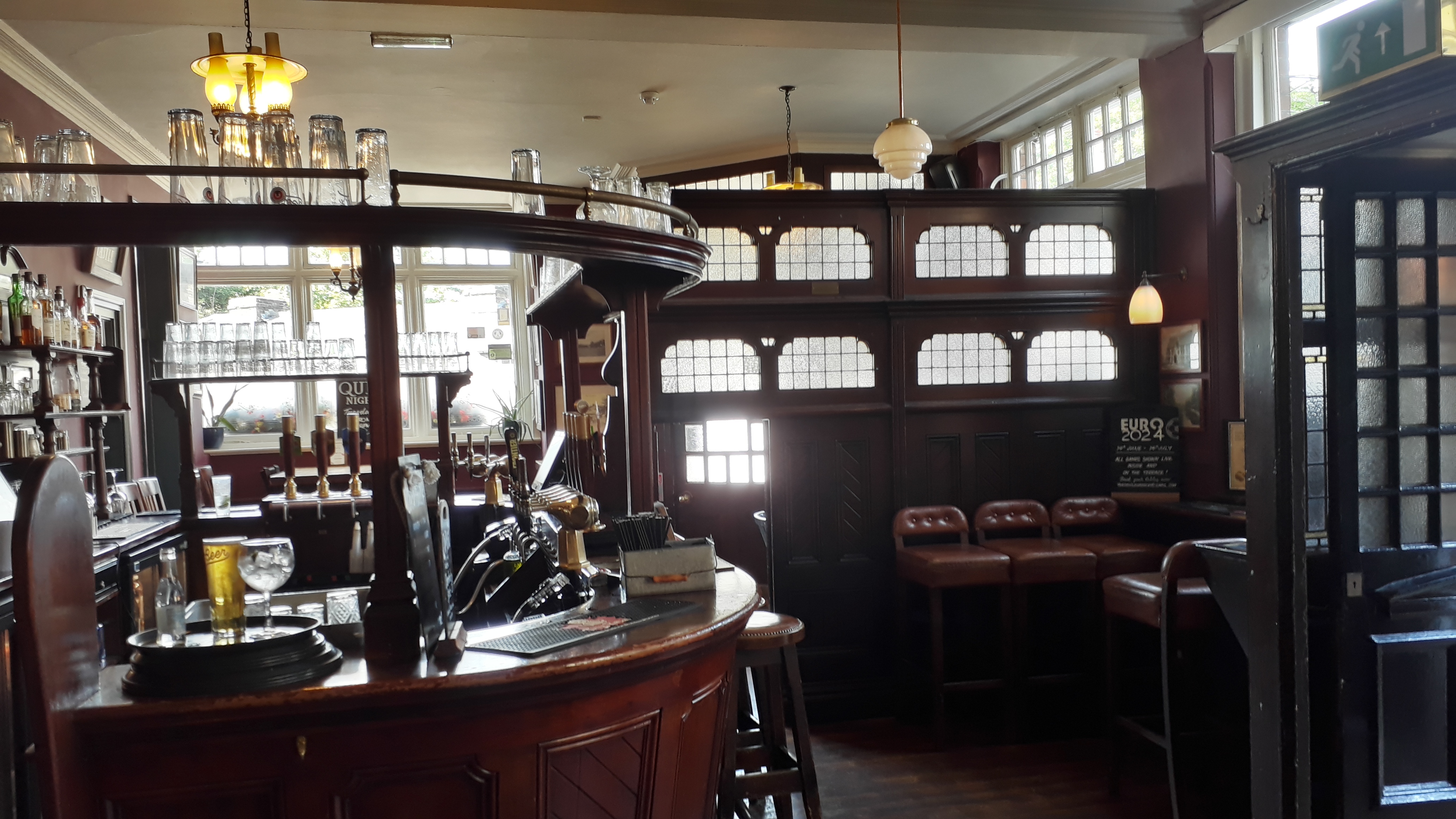
Situated on a residential street near Harrow School is an imposing looking pub, built at the beginning of the Edwardian era in 1901. A Fullers pub since its inception, many of its original features still remain, including its distinctive curved shaped bar with wood panelling and surrounding bar rail, which rather intriguingly the area is separated in two by a glazed timbre screen with a low hanging door, this partitions the bar into two areas, namely the saloon bar and the public bar, which was a once common feature in most pubs at the time when the pub was built, but over time has increasingly become rare as ever-frequently succesive owners have demolished their partitions in return for extra space. Moreover, the pub still features two entrances to both respective areas which helps with the footfall during busier times, and boasts two sets of handpulls which are both in continuous service. Over at the rear side of the bar is the former billiards room which has repurposed as a dining area, meanwhile behind the bar there are two intriguing looking rooms, the snug room fulfils its purpose as a private drinking area even down to its serving hatch, although the latter is now boarded with glass and the original furniture has long since been removed. Adjacent to the snug, is the former severery which has now been repurposed as a secondary indoor dining area, notably it boasts a large number on antique clocks on its walls, leading it to be amusingly dubbed, The Clock Room.


With enough original features present, it is easy to see why the pub is Grade II listed and has been awarded a three-star status by CAMRA’s Pub Heritage Group.  However, I think the latter award is too generous as parts of the original architecture have renovated, namely the snug and billiards room as some of the original furniture has been removed or the occasional architectual feature has been altered, quite deservingly it really shouldn’t get more than 2 stars for its endeavours.  Moreover, as you leave the entrance to the public bar, one enters an impressive length of stairs that leads into the raised pub garden. A relatively recent addition to the pub, it seemingly looks out of place with its imposing structure of wooden gazebos and dining tables, which gives the area a continental feel during the summer months. Interestingly, at the back of the garden there is the former pub sign, featuring a decorously detailed piece of art work that features a knight returning back to a castle, alas its owners Fullers have since replaced the pub sign with a bland motif featuring the outline of a castle. Now, I’m all for pub gardens yet the raised area makes it inaccessible for wheelchair users which would surely put some people off from coming here.


Rather typical for a Fullers pub, on cask it features a number of their beers including classics like London Pride (4.1%) and ESB (5.5%), also included is Hophead (3.8%) by their subsidiary Dark Star Brewing Co., which Fullers took over in 2018, a few years later current owners Asahi closed down their Partridge Green brewery and relocated operations to Fullers main brewery site in Chiswick, so now all three beers available in cask are made ‘in house’. There is also supposed to be a guest beer, which was notably absent on my visit, along with a wide and intriguing selection of keg beers/ lagers and a small range of bottled beers in the fridge that featured a number of Fuller’s products, which were a bit in short supply in this instance. I ultimately went for a pint of ESB, which at £5.95 was the priciest pint I have yet sampled in a Fuller’s pub, this is clear living proof of the adverse effects of inflation and the ever increasing rates are having on the average price of a pint, which I have seen increase by nearly £2 since I began my drinking odyssey during the tail end of the Noughties. Thankfully for such an expensive pint it was rather quaffable and flavoursome, its distinct butterscotch flavours suitably laced with a subtle background of bitterness and maltiness; although I prefer the bottled version which is stronger and has more character, although for a cask pint this was quite decent.


Rather typical for a pub nowadays, this pub features extensive dining facilities both indoors and outdoors, which boasts traditional English pub fare with a modern ‘gastro’ twist. One may frown at the reduction of drinking facilities, but this is the one of the principal means of income for the pub, and without this service it would struggle to survive. However, unlike those country pubs that have been repurposed as gastro hellholes, you are not greeted by host who asks for your table number and there’s none of that snobbish sense of exclusivity. It still largely feels like a homely neighbourhood bar where you are met with a friendly atmosphere and a comfortable environment, which is embellished with its impressive array of brick-a-back from embossed mirrors, cricket bats, framed photos, hats, wall-mounted deer heads and antique clocks that adds to the overall ambiance. It is easy to see why it was voted Pub of the Year by the local CAMRA Harrow branch in 2014 and 2016 respectively, because it delivers its purpose as a good service to its locals. From an architectural angle, this is certainly one of the more interesting pubs I have yet visited during my travels, so if you’re a fan of historic pub interiors, then this place is a must-visit on your bucket list, if you happen to be passing by.


Friday, April 19, 2024

Pub Guides: Tapping the Admiral, Kentish Town

Address: 77 Castle Road, Kentish Town, London, NW1 8SU


Opening Hours: Noon – 11pm (Sun-Tue), Noon – Midnight (Wed-Sat).


Tel: 0207 267 6118


Kentish Town is well known for its extensive array of pubs to choose from, and a good number of them offer real ale and feature historical architecture dating back to the 19th century. Most of these pubs however tend to be around the high street, yet sometimes if you go around the back-streets you may find some neighbourhood gems. Over by the railway arches by Castle Road is a pub that has stood there for many years and has served generations of customers through its doors, its by definition alone a quintessential local. Tapping the Admiral has resided in the area for nearly 175 years, built on the site the former Castle Tavern, the current building was constructed after the original was pulled down in the 1850’s to make way for the development of Castle Road and nearby Lewis Street. A new pub was soon constructed in its place and was named the Trafalgar, in honour of its famous customer Horatio Nelson who used to visit the location when it was known as the Castle Tavern with his uncle William Suckling. The pub has gone through a number of names over time from the likes of Tavern Inn the Town, Fuzzock & Firkin and the Trafalgar Tavern, its current name (Tapping the Admiral) is in tribute to the historical incident in 1805 following Nelson’s death at the Battle of Trafalgar when his body was stored in a barrel of brandy during the journey back to England, rumour has it that the crew of the HMS Victory tapped the barrel and drew brandy from it, to toast to their fallen Admiral, hence the moniker ‘Tapping the Admiral’ which grew out of this supposed legend. 


Many of the original Victorian era fixtures remain, such as the oak panelled l-shaped bar, Regency style fireplace, mirrored pillars and an ornate oak gantry above the bar that displays a large collection of pump clips from various beers the pub has served over the years. Like most pubs dating from this era, it has since been renovated, the three original entrances have been reduced to one, and the former public, saloon bar areas have been removed and opened up for a larger open-plan area; there is also a rather narrow pub garden at the back with covered seating areas, the garden shares with the tradesman entrance so it can feel a bit crowded, although most of the spent barrels are kept outside near the entrance. Inside, there is plenty of seating around, and there is also bar-stools by the bar, and another high-top counter near the bar that offers more seating, which is beneficial given that the bar can get busy at times, especially during early-evenings and weekends. There is a lack of gaming areas, although the pub hosts weekly quizzes every Wednesday, live music events and shows live sports on occasion. Meanwhile for the Brewerania specialist, this place is a cornucopia of memorabilia, there’s everything from embossed mirrors, a poster for Fuller’s beers, an original Greene-King sign, a Whitbread ornament adorned in gold, vintage posters, an advert for Truman’s Beers and Ales and a collection of bottles behind the bar all linked with a Nelson theme including the appropriately named Tapping the Admiral (4%), a commemorative ale produced by Shepherd Neame to mark the bicentenary of the Battle of Trafalgar in 2005. 


Since the pub is a free house, there’s also a changing selection of real ales on offer, including 7 changing beers and 1 regular. For a good number of years, their regular beer used to be Nelson’s Whiskers (4%) named in honour of the pub’s cat, who still makes appearances now and then. But that has since been retired and has been replaced with Redemption Trinity (3%), although due to the pub’s long affiliation with CAMRA, they do offer a 30p discount for members of all EBCU organisations including CAMRA. Furthermore, the pub offers real cider which is usually limited to one or two barrels depending on the time of year, and every couple of months there is a tap takeover by a small independent brewery. There is also an extensive range of spirits available for those discerning cocktail drinkers, a small array of bottled beers and the ubiquitous selection of keg beers and lagers featuring examples from Camden Town and Redemption Brewery. A full restaurant menu is also available that includes Lunch, Small and Large Mains dishes, Burgers and a Pie selection, along with roasts served only on Sundays, although like most pubs in the local area, the food tends to be on the pricier side; on a disappointing note, there only ever seems to be one dessert regularly available, in this case Sticky Toffee Pudding with toffee sauce and ice cream. 


On the whole, this pub is shining example of what a great pub should be, as it offers a great range of real ales and ciders, which always change weekly so you never know what to expect. This pub is often busy with customers, and is easy to see why it has been voted four times winner of the CAMRA North London Branch Pub of the Year (2013, 2015, 2018 and 2023 respectively). Moreover, it has featured in the CAMRA Beer guide for a good number of years and is a member of their LOCale scheme which helps champion and promote beers from affiliated London based breweries. Furthermore, due to its status as a revered local landmark, in 2016 it was listed as an Asset of Community Value, which was renewed again in 2021, hopefully at one point soon this pub will become a listed building. Overall, this pub is quintessential local boozer, tucked away from the hustle and bustle of the nearby Kentish Town Road. This place is perfect to a sample a quiet pint or two, read a paper or watch the world go by, so if you happen to be area and can’t work out which pub to choose from, then this place is the perfect choice.