Wednesday, April 03, 2024

Revived Beers

Every now and then, they’re certain beers out there that have become revered by the general public and critics alike, these beers tend to stand out from their competitors, often are revered for their excellence and tend to gain a sizeable number of awards. Yet too often we take them for granted and when the breweries that produce these iconic beers cease production whether its through enforced closure by their business owners or bankruptcy due to ongoing money problems, their loss is deeply felt as it also means the cessation of brewing production. As recently as February this year, this very instance occurred when Elland Brewery closed down after it announced that they were going into liquidation. They were famous for their 1872 Porter (6.5%) which won a slew of awards over the years, including CAMRA’s Champion Beer of Britian in 2013 and 2023 respectively, yet even a flagship beer is never too far away from being banished to the history books. Yet what if it was possible to revive some of these classic beers for continued consumption, in recent times we have seen this with the likes of Thornbridge taking on the production of Pale Rider (5.2%) following the closure of Kelham Island Brewery in May 2022. Yet not only has the loss of contemporary beers spurred other brewers to resurrect them, in some instances they have looked to the pages of history and sourced original recipes for beers from long-defunct breweries. In some cases, like in the instance for Hook Norton, Fullers or St Austell they went back to their old brewing logs to revive long forgotten classics, whilst occasionally entire breweries like Phipps and Allsopps have been brought back to life in a bid to revive and resume production of these once iconic beers, here is a potted guide that includes several well-known examples.


Audit Ale (6.2%) – Westerham

At one time Westerham based brewery Black Eagle was one of major breweries in Kent with a substantial number of pubs in Kent and London; however, in 1959 it was taken over by Ind Coope and six years later they closed the brewery. Fast forward to 2004, Robert Wicks launched Westerham Brewery in a bid to restore brewing to the town. Wicks sought to revive some of the beers from the former Black Eagle brewery, where he borrowed recipes from a 1938 brewery log, utilized the same hard water supply from Greensland Ridge and incorporated the original yeast cultures which were preserved by the then head brewer in 1959 and donated to the NCYC (National Collection of Yeast Cultures) in Norwich at the time when Ind Coope took over the brewery. One of the former brewery’s flagship releases was Audit Ale (6.2%) inspired by the tradition when colleges brewed strong ales every October following the hop harvest, then matured for many months before being served at the annual Audit Feast towards the end of the academic year. Brewed to the same strength (as produced in 1938), made with pale and crystal malts along with a huge charge of Kent Goldings hops as Wicks proclaimed. Adrian Tierney Jones once noted “it’s a noble and assured beer, with plenty of poise on the palate, there’s a restrained vinous-like sweetness, the suggestion of raisins and currants steeped in booze, some slight chocolate, plus a whisper of banana.”[1] This beer was revived for 2nd SIBA South East of England beer festival and took gold medal in the strong ales category, it has subsequently won a range of regional and national awards. The beer is currently a regular part of their range, sold in can, bottle and cask.


Crafty Stoat (5.3%) – Wibblers

Ushers Brewery was established in Trowbridge in 1824 by Thomas Usher and his wife Hannah. For the next 45 years, they strove tirelousy to establish the brewery in the face of stiff competition. Later they were joined by their three sons in 1844, and by the end of the 19th century the brewery had expanded operations, merging with Fanshaw & Palmer of Donnington, Berkshire to become Ushers Wiltshire Brewery Ltd. Over time they acquired more breweries across the region, increasing the number of public houses. In 1960, they were taken over by Watney Mann, by 2000 the company owned 60 managed houses and 740 tenancies, yet the brewery was running at 70% capacity of its 600,000 barrel per year volume, then owner Robert Beare took the decision to close the brewery and production of the beers were sold onto Wychwood. Since 1991, Wibblers Brewery has been operating in Southminster, Essex, where they have won a number of awards for their extensive range of beers, lagers and ciders. When it came to produce a stout, they looked to the history books and in conjunction with the Durden Park Beer Festival, they tracked down an 1885 recipe for a stout from Ushers. The beer was created with assistance from members of the Craft Brewing Association and the UK-Homebrew Digest at the 2008 Flocculation event. It is brewed with Fuggles hops and six different types of malts, that help give its unique flavour. Jeff Evans commented it as “a dark ruby beer with hints of caramel and chocolate from the dark grains in the aroma; the taste is full bodied, slightly smoky and bittersweet, with creamy mocha coffee flavours and a little dark berry fruitiness.”[2] This beer has gone onto become a regular part of their main range, and has won a number of regional awards including SIBA East and CAMRA East where it was notably awarded Champion Beer of East Anglia in 2015, the following year they won the coveted gold award for Champion Winter Beer of Britain (Stouts) at the Great British Winter Beer Festival.


Double Stout (4.8%) – Hook Norton

Uniquely this is only example in this selection that doesn’t come from a defunct or revived brewery. Hook Norton Brewery has been treading the boards since 1849 when John Harris established a malthouse in the Oxfordshire village of Hook Norton. Commercial brewing commenced in 1856, and by the 1880’s they commenced construction of their iconic tower brewery which continues to run to this day. Double Stout (4.8%) was first brewed in 1898, its name “reflects the old practice of marking a certain number of crosses on a cask to indicate strength”[5] Des de Moor notes. The beer was a fine example of an English stout with a smooth and full-bodied mouthfeel and a prominent hoppy aftertaste, yet its commercial life was short and by 1917 it was discontinued. Its decades long slumber was ended when it was triumphantly relaunched in 1996 to great acclaim. Made in the traditional way, it uses black, brown and Maris Otter pale malt along with Challenger, Fuggles and Goldings hops. Jet black with ruby overtones, Roger Protz described it as “the palate is bittersweet with chocolate, coffee, dry smoky malt, a hint of caramel and an underpinning of bitter hop resins.”[6] This beer has subsequently become a regular part of their bottled range, and available on cask on a seasonal basis. It has also won gongs at the World Beer Awards, Brewing International Awards and the International Beer Challenge.


India Pale Ale (5%) – Allsopps

During the 19th century, Allsopps was one of the major breweries in Burton, established by Benjamin Wilson in 1742, his son Benjamin Jr later took over and helped turn it into a profitable company. Benjamin Jr employed his nephew Samuel Allsopp, and since he had no issue, Wilson sold to him in 1807, the company became known as Samuel Allsopps & Sons in 1822. During this time, India Pale Ales were increasingly being exported to the profitable Indian market, with Frederick Hodgson dominating the competition. In a bid to counter Hodgson’s unscrupulous business practises, Henry Jeffrey notes “Campbell Majoribanks, a director at the Company, approached Burton brewer Samuel Allsopp to make a rival beer. Allsopp brewed a sample in a teapot which met with approval and the beer was shipped to India from 1823.”[7] Their IPA became one of the brewery’s landmark products, not only did it help cash in on the growing Indian trade, it also did well domestically by displacing the likes of Porter as punters went for brighter, fresher beers. However, the brewery’s fortunes began to slide when Percy Allsopp built a larger brewery site in 1897 that featured facilities for brewing lager, unfortunately there wasn’t much demand and Percy resigned within months of its launch. His brother George took over and despite his best efforts to keep the business afloat, the family soon lost control of the brewery and it went into receivership in 1911. It limped on until 1934 when it merged with Ind Coope, before gradually vanishing altogether by the early 1960’s when it joined Ansells and Tetley to become Allied Breweries. Jamie Allsopp had a lifelong endeavour to restore his family business, and in 2020 he re-established the company. Not only was he able to acquire the famous red hand trademark from Brewdog and other brands from Carlsberg, he also managed to acquire an original brewing ledger from 1934 courtesy of brewer Steve Holt (of Kirkstall Brewery) who had won at auction, along with the original yeast strains preserved at the NCYC. One of their first ‘re-releases’ was India Pale Ale (5%) which debuted in 2021, made with Maris Otter and Chevalier malts, along with Bramling Cross, Fuggles, and Challenger hops, Beer Today noted at the time “this recreation is darker and clearer than most modern IPAs. Malt and hops combine on the nose to create notes of fresh hay, citrus, and dark fruit, with a hint of caramel. On the palate it’s rich and rewarding, with grass and spicy notes playing off a light toffee-like base, before a dry, lingering finish.”[8] This beer is now part of their regular range, and was soon joined by other former products including the likes of Pale Ale (4%), Pilsner (4.6%) and Arctic Ale (11%) respectively, Jamie intends on reviving other classic beers from the brewery in the near future, so watch this space. 


Norfolk Nip (7%) – Woodfordes

Steward & Patteson Ltd was established in Pockthorpe by John Patterson in 1793, by the end of the 19th century they had become one of the major brewers in Norfolk, owning a vast number of pubs across Norfolk and Suffolk, by the time it was taken over by Watney’s in 1963 they owned 632 pubs at the time and two breweries in Norwich and Ely respectively, however due to growing financial issues brewing had ceased by 1970 and the breweries were decommissioned. Woodfordes Brewery was established in Woodbastick, Norfolk in 1981 by Ray Ashworth and Dr David Crease, whom named the brewery after James Woodforde, a 18th century parson noted for his love of good quality beer. In 1992, to mark the tenth anniversary of publication of the local Norfolk CAMRA magazine Norfolk Nips. the brewery revived one of Steward & Patteson's iconic beers, Norfolk Nip (7%). First introduced in 1929, it was a barley wine which true to its name was sold in Nip bottles that measured around 180ml or a third of a pint. The revived version was sold in 375ml bottles, and dade with a combination of crystal, Maris Otter pale and chocolate malt together with Goldings hops. Jeff Evans describes it as “a deep ruby colour beer with dark chocolate and red berries in the aroma. The softly warming bittersweet winey taste, features treacle toffee, dark chocolate and dried stone fruits, before a firmly dry, nutty, bitter chocolate finish.”[2] Reflecting on the beer, the brewery's managing director Rupert Farquharson commented “the revitalised label has enabled us to move the look and feel forward whilst staying true to the traditional elements of this historic recipe.”[9] This is beer is generally sold in bottle on limited release, it was even sold through Marks & Spencer for a while.   


Phipps IPA (4.3%) – Phipps

The brewery was founded in 1801 by Pickering Phipps and production moved to Towcester in 1817, and over the next 165 years it became one of Northamptonshire’s major breweries and the 9th largest in the country, owning pubs in areas like Leicester, Oxford, Peterborough and Warwick. Following a takeover by Watney’s in 1960, its name was dropped four years later and they ceased brewing altogether in 1972. In 2004, brothers Quentin and Alaric Neville started making plans to resurrect Phipps IPA (4.3%) and obtained the rights from then owners S&N. Together with brewers Dusty Miller (former head brewer at Phipps) and Tony Davis, along with Pat Heron who brought along the old brewing logs, they sought to recreate the beer using 1930’s recipes that had been preserved by former employees. One of their flagship beers, it was first introduced in 1868 following the opening of their new brewery site, originally brewed at 4.8%, it was dropped to 4.3% following the outbreak of WW1 when the government ramped up taxes on alcohol. Described as a sessionable sweet beer it became widely popular with local workers from the tanneries and “Phipps IPA became the county’s favourite beer and was sold as the company’s best bitter right through to the late ‘60s”[3] the Nene Enquirer note. The beer took four years of development and research at Grainstore Brewery before it was re-released for the first time in 40 years in 2008, this modern recreation is faithful to tradition, utilizing pale malt along with a blend of Goldings and Fuggles hops that helps give its distinct and full-bodied flavour. The brewery described it as “the balance of bitterness and sweetness, allied to a smooth hoppy after-taste, creates a most drinkable pint and our flagship brew.”[4] This beer continues to be sold as part of their core range, and its success encouraged the brewery to resurrect a number of other former beers including the likes of Ratcliffe’s Celebrated Stout (4.3%), Gold Star (5.2%), Diamond Ale (3.7%), Bison Brown (4.6%) and Stingo No.10 (8.3%). Finally in 2014, they transferred operations from Grainstore, when they acquired their former Albion Brewery in Northampton.


Prize Old Ale (9%) – Dark Star  

The story of this beer’s long road to revival was traumatic and thrilling. It was originally brewed at Gales Brewery in Horndean, Hampshire which was established in 1847 by Richard Gale when he purchased the Ship and Bell along with its brewery. The site later burnt down, and with the insurance money in 1869 he established a larger brewery in the town. In 1922 William Barton Mears Jr became head brewer following the suicide of his predecessor William Sydney Steel; with the wartime restrictions of strong ale lifted the previous June, Mears took advantage of this and in 1923 released a strong dark old-aged ale with an original gravity of 1095ยบ[10], it was known as Prize Old Ale by 1928. It was inspired by dark old aged beers made before WW1, Martyn Cornell notes “the beer is produced using the solera system, where a batch of each new brew has a quantity of the previous brew added to it. In return a vat of the old brew is topped up with new beer every year, ensuring the continuity of microorganisms going back year upon year to, in this case, the early 1920s.”[11] To add towards developing its unique flavours, the beer was matured in a wooden hogshead that had its own unique floral and forna (including lactic bacteria), where it as matured between six months – one year before being dispensed into bottles. In late 2005, Gales was brought out by Fullers, who closed the brewery in March 2006. Some of their beers including Butser (3.4%) and Festival Mild (4.8%) were kept on for a few more years before being discontinued. In the case of Prize Old Ale (9%) due to its unique status as a rare example of a stock ale, there was a concerted effort to keep it going. John Keeling (former director at Fullers) ensured the contents of the last batch made at Gale’s were transferred to Fullers in 2006. Since they weren’t able to acquire the original wooden vats, Keeling organised production of 80 barrels worth of Prize Old Ale, which Derek Lowe (former head brewer at Gale’s) inoculated 20 barrels with samples made from the last batch at Gale’s, these were then incorporated into the vat. Fullers only made two batches (in 2007 and 2008) before it was discontinued. Despite this setback, Keeling maintained 42 barrels of POA and hid them in the Chiswick tank room. In 2014, Henry Kirk (head brewer at Dark Star) discovered these barrels and recalled that the beer was reminiscent of Rodenbach Grand Cru (6%)[12], and was determined to resurrect it. So, in 2018, he brought some samples made from the last vat of POA (made at Fullers) in order to maintain the unique family of microorganisms, for use in a later batch. A tanker of POA was delivered to the brewery the following year and Kirk set to work, he based the re-release on a recipe from Gales own records dating from 1989. He incorporated some of the last batch made at Fullers into the brew, in order to extract the unique flavour, which was blended into the new batch, the beer was matured in a wooden vat that cost £15,000 to produce. After three years of development, the beer was re-released in October 2022 where it sold out in 48 hours.[13] The modern version is made with black and crystal malts, along with Fuggles and Goldings hops, remarked as a complex beer Roger Protz described it as “the beer has a musty aroma with an intense fruitiness of dates, raisins and sultanas. It’s acidic in the mouth with rich fruit, and spicy and peppery hops. The finish is long and fruity with some sweetness developing to challenge the sharp acidic notes.”[14] Shortly after its release, the brewery’s owners Asahi closed down Dark Star and transferred their brands to Meantime Brewing, despite this impediment POA was released again last Autumn to great acclaim, and will continue to be sold on a seasonal basis.


Winter Royal (5.4%) – Rebellion

At one time of the major breweries in Buckinghamshire, Wethered & Sons was established in Marlow by George Wethered in 1758. The management of the brewery was a strictly family affair passed through the generations, and in 1788 his grandson Thomas purchased a freehold for a larger brewery site. For the next two centuries, the brewery remained in continuous operation producing beers like Wethered’s S.P.A, Wethered’s Bitter and Winter Royale which became popular locally; in 1949 the company was purchased by Strong & Co and subsequently in 1968 it was taken over by Whitbread. The brewery site was closed in 1988 for commercial redevelopment, through their subsidiary, Whitbread Developments Ltd. A few years later in 1993, Rebellion Brewery was set up in Marlow in a bid to re-establish the town’s long brewing heritage, creating beers using traditional methods whilst utilizing the latest technology. In 2016, Rebellion revived one of Wethered's flagiship beers, Winter Royale (5.4%), by utilizing the original recipe which used Fuggles and Goldings hops along with locally grown barley from Bencombe Farm in Marlow-Bottom to add to its authentic taste, which the brewery stated “the result is a deep, ruby winter warmer at 5.4%, with a rich maltiness, soft bitterness and a fantastic late and dry hop aroma.”[15] Mark Gloyens (brewery director at Rebellion) described the genesis for the idea “the idea was spurred on by the fact that we had bought some barley from the farmer here, it just seemed to tie in together quite nicely – having the original recipe brewed locally and using local ingredients.”[16] Although Rebellion managed to acquire the original recipe, for several years they weren’t able to release it under its own name as it’s copyright was owned by AB InBev, Rebellion later submitted their own application for a trademark which went uncontested, and they successfully brought back the rights to sell the beer under its original name.  Commenting to the press at the time of its release, Stu Sutherland stated “Rebellion are very proud to be part of the Marlow community and we’re happy to bring some of the town’s brewing history back to life.”[17] Initially sold as a one-off release for the Christmas period, its success encouraged the brewery to re-release it on an annual basis, and it continues to be sold in both cask and bottle during the Winter months.


References

[1] ‘World Bottled Beers: 50 Classic Brews To Sip and Savour’ by Adrian Tierney Jones, Jacqui Small LLP, 2014

[2] ‘CAMRA’s Good Bottled Beer Guide, 8th Edition’ by Jeff Evans, CAMRA Books, 2014

[10] Note: In modern terms this measures at 9% alcohol.

[12] Note: Rather ironically Rodenbach Grand Cru was inspired by English Stock Ales, after founder Eugene Rodenbach toured a number of British breweries in the 1870’s, learning more about how Stock Ales and Porter were brewed.

[13] Note: Roger Protz noted that it was the fastest-selling beer every brewed at Dark Star.

[17] ‘Rebellion Brewery uses historic recipe to revive favourite 'Winter Royal' beer, made by Wethered Brewery’ by Stephanie Wareham, Bucks Free Press, 21st December 2016 

Sunday, March 31, 2024

Beer Review: Samuel Smith's Chocolate Stout

Name: Chocolate Stout

Brewery: Samuel Smith

ABV: 5%

Style: Stout

Location: Tadcaster, North Yorkshire


Aroma: Fruity, with lashings of chocolate. Some coffee notes present. Sweetness comes through strongly. 


Colour: Jet black with one finger tan coloured head. Typical frothy head, synominos of Northern beers. 


Taste: Sweet with noticable flavours of milk chocolate, heavy and creamy mouthfeel. Roasted malt complements the chocolate well, and gives it a slight bitter background. Sweetness is at fore in this beer, chocolate flavours aren't easy to determine. A good effort for a chocolate stout, that uses actual chocolate in the mix. 


Rating: 7/10

Tuesday, March 26, 2024

Beer Review: Thornbridge Jaipur

Name: Jaipur

Brewery: Thornbridge

ABV: 5.9%

Style: IPA

Location: Bakewell, Derbyshire


Aroma: Distinctly fruity with tropical fruits such as pineapple, guava and grapefruit present; rather hoppy with hints of citrus permeating through in the background, with some residual tartness from the malt.


Colour: Straw coloured golden yellow with a hefty off white two finger head, which is unstandable given that they use low colour Maris Otter malt for their base. It is cloudy, which indicates that they don't use finings in the mix. 


Taste: Rather sharp and bitter with a background of maltiness cascading through. It has a creamy mouthfeel, without too much carbonation getting in the way. The menagerie of hops that include the likes of Chinook, Centennial,  Ahtanum, Simcoe, Columbus and Cascade rumble in the glass, trying to compete for attention, which helps give the beer its distinct flavour profile. Their is some hints of citrus fruit present, yet the overwhelming reliance of hops puts that quickly aside.


Verdict: A distinct and flavourful IPA that doesn't shy away from packing a punch to the tastebuds. The use of several different hops helps add to its overall flavour, yet the over-reliance of hops mutes the malty and fruity notes that help charecterise a traditional IPA, which somewhat takes away from the overall drinking experience. This beer is closer to a Brut IPA or NEIPA in style, so expect don't expect traditional flavours here. Although this flagship beer has won a number of awards for the brewery since it was first released in 2005, as an IPA I wouldn't rate this among my favourites.


Rating: 7/10

Tuesday, March 19, 2024

The Curious Case of Beer Flavoured Foods

It is well known that there are hundreds of dishes out there that use beer in their recipes, including stews, soups, battered fish, chilli-con carne, cake, bread, marinated meats and roasts. What is less known however is the small number of breweries who have engaged in producing food items infused with their own beers. This practise is albeit uncommon as its often difficult for breweries to find the extra space to produce food items, and where this does occur, the production is normally outsourced to another company. Such as the case when Everards collaborated with Leicester based company Drivers Pickles where they produced Tiger Ale Chutney infused with their flagship product Tiger Ale (4.2%), moreover Tring Brewery worked with Grim Reaper Foods to develop a hot sauce permeated with their powerful IPA Raven King (5.5%). Or more recently in February last year when Powys based brewery Monty’s teamed up with Get Jerky of Welshpool to develop Real Ale Beef Jerky, flavoured with their stout Dark Secret (5.5%). Although using beer in food can be seen as innovative, truthfully many of these products are hard to come by and often sold at brewery shops or on a limited strictly local basis; however, if you dig deeper, you’ll find a marvellous menagerie of beer flavoured food products situated throughout the land.


Quite often, you’ll find beer used in condiments such as Chutneys, Sauces and Mustard as its far easier to produce and implement that other food products; Hook Norton notably has a varied range with the likes of, Old Hooky Mustard Double Stout Chilli Mustard, Old Hooky Beer Chutney, Flagship Smooth Mustard and Haymaker Smooth Mustard for instance; whilst St Austell boasts the likes of Korev Sweet Chilli Sauce, Tribute Ale Chutney and Mena Dhu BBQ Sauce for instance; Chiltern features the likes of Dark Old Ale Chutney, Chiltern Ale Mustard and Chiltern Porter BBQ Sauce; and furthermore Andwell’s once featured a range of condiments in their range using their Resolute Bitter (3.8%) in the likes of Resolute Chilli Jam and Rich Resolutely Chutney, whilst King John (4.6%) was used in the regally named Royal Red Onion Marmalade. Sometimes specific beers may be used such as Theakston’s Old Peculier (5.6%) in products like Peculier English Country Mustard, Peculier Red Tomato & Chilli Jam and Peculier Apple, Peach & Apricot Chutney for instance; whilst Tring utilize Death or Glory (7.2%) in their Chutney and Wholegrain Mustard products respectively. Meanwhile, Thornbridge’s range of sauces are based around their iconic beer Jaipur (5.9%) and include the likes of Jaipur BBQ Sauce, Jaipur Mango & Pineapple Table Sauce and Jaipur Birthday Hot Sauce for instance.


Crisps always go well with beer, so it quite an occasion when the two are combined together. A notable case occurred in 2015, when Adnams teamed up with Fairfields Farm whom specialise in producing gourmet hand-cooked crisps, when they came up with Ghost Ship Crisps which were flavoured with the brewery’s iconic pale ale Ghost Ship (4.5%). It is quite rare to see breweries collaborate with crisp manufacturers, although through the years we have seen the likes of Roast Beef & Spitfire Ale (Kent Crisps), Hobgoblin Spitroast Steak (Burts) and more recently Steak & Butcombe Ale Pie Crisps (The British Snack Co.). Other types of pub snacks have also been tried, such as Adnams’ Ghost Ship Peanuts (Mr. Filberts), Tring’s Death or Glory Charcuterie Sticks (Chiltern Charcuterie), Monty’s Real Ale Beef Jerky (Get Jerky) or the humble Pickled Onion, which includes the likes of Peculier Pickled Onions (Theakston), Found Hope Beer Pickled Onions (Macintosh) and Fuggles Hop Pickled Onions (Chiltern) for instance. Notably in 2020, Grainstore Brewery released a range of flavoured pork scratchings that included a variety of flavours dervied from various beers in their extensive range including Rutland Panther (3.4%), Rutland Osprey (4%) and Ten Fifty (5%). Moreover, beer has often been noted as a reliable ingredient in pies, and in 2018 Pukka Pies released a Steak & Ale pie flavoured with St Peter’s Best Bitter (3.7%), whilst Burford based Cotswold Pie Co. created a Steak & Wadworth Ale Pie utilizing Wadworth’s flagship bitter 6X (4.3%) in the mix, this promising pie has gone onto win multiple awards including winning Silver at the British Pie Awards in 2021 and 2022, a 1 star at the Great Taste Awards the same year. Cheese has often been described as an appropriate accompaniment to beer since the number of beer and cheese pairings are infinite, which in turn has inspired some producers to produce cheeses infused with beer in the mix, cheddar is quite often seen as the cheese of choice due to its relatively mild qualities that marry well with the comparatively stronger flavours of beer. For instance, Chiltern recently released Chiltern Beer Cheese fortified with their Beechwood Best Bitter (4.3%), whilst the Cheshire Cheese Co. developed Old Hag which features the intriguing combination of cheddar, wholegrain mustard and Old Hag Stout (5.2%) by Macclesfield based brewer Wincle Beer, and Wensleydale Creamery once utilizd noted strong ale Riggwelter (5.7%) from Black Sheep Brewery, for their Fountains Gold Cheddar.


For the sweet tooth, marmalades and conserves are a popular option. Hook Norton notably developed Off the Hook Marmalade that utilized their Off the Hook (4.3%) with Seville oranges to create an unusual beer flavoured marmalade, meanwhile, Timothy Taylor has taken the innovative approach of mixing marmalade with their Poulter’s Porter (4.8%) to create a Porter Marmalade. They also teamed up with Botham’s of Whitby to create a fruit cake flavoured with Landlord (4.1%), other Yorkshire based breweries have also created their own Fruit Cakes including Theakston whom created a cake using Old Peculier (5.6%) and their close relations at Black Sheep Brewery who created a cake infused with Riggwelter (5.7%). Meanwhile at the tail end of the year, an increasing number of breweries have been releasing Christmas Pudding infused with their own tipples, quite often using ales from the stronger end of their range such Chiltern’s take on the festive classic which is flavoured with their Lord Lieutenant’s Cream Porter (6%), whilst Harvey’s of Lewes utilize their Christmas Ale (7.5%) in their concoction, and Adnams use Broadside (6.3%) with theirs. In 2015, Chelmsford based business Lillypuds established by Alison Lilly created a Christmas Pudding that utilized Chockwork Orange (6.5%) from Brentwood Brewery, in the first year alone she sold 600 puddings to shops around Essex and a further 500 mini-puds to local restaurants and pubs, this remarkable pudding continues to be sold on a yearly basis.  


The business of breweries infusing their beers with food products is still a cottage industry at present, but in recent years a growing number of breweries have joined the bandwagon, working with local and national food producers to create their own innovative creations; over the years, we have seen a whole manner of beers innovated with food, from marmalades infused with IPA to cheddar cheeses flavoured with bitter and fruit cakes macerated with strong ale. There’s even a growing selection of snacks to choose from beef jerky, pork scratchings and crisps, that are flavoured with all manner of beers. The possibilities are endless, and in the ensuing years as more breweries release their own beer flavoured food products, perhaps we’ll see a surge in productivity and availability as these products become available on a wider and potentially national basis.


Tuesday, March 12, 2024

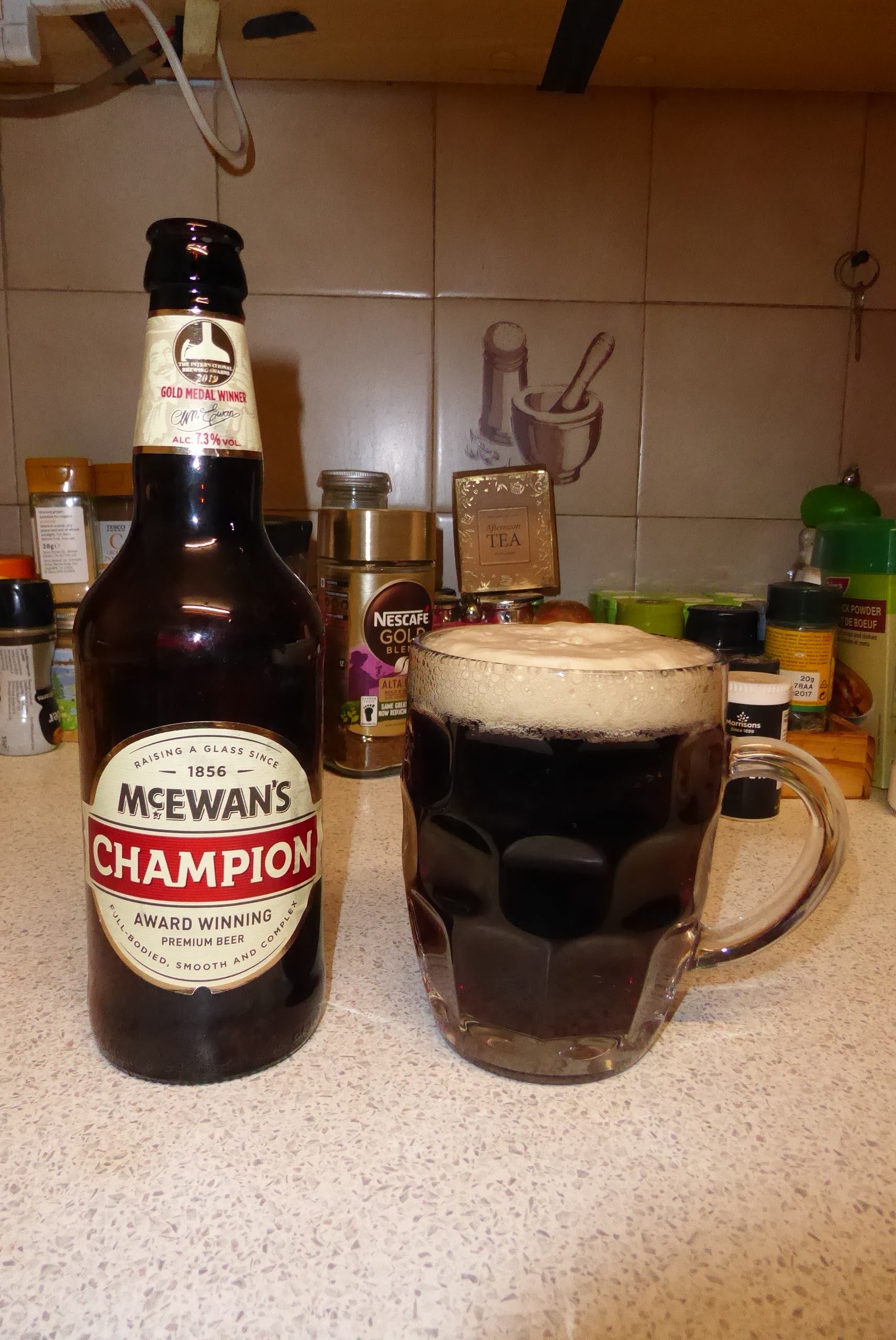
Beer Review: McEwans Champion

Name: Champion

Brewery: McEwans

ABV: 7.2%

Style: Strong Ale

Location: Edinburgh, Scotland


Aroma: A whiff of fruitness instantly invades the senses, with notes of berries, cherries and figs all in the mix. A background of a caramel comes through, along with a strong hint on banana. 


Colour: Deep ruby red, with a two-finger tan coloured head.


Flavour: A pleasant oak like bitterness is immedietely noticeable, assaulting the tongue with every sip. The background of banana is evident, along with hints of sweetness the help offset some of the bitter notes. There are traces of sherry in the background, which is quite understandable given its scene. It is aided by a creamy mouthfeel, with good lacing around the glass.


Verdict: A potent yet thoroughly enjoyable beer with plenty of flavour and personality. With it's multi-layered notes of banana, oak, sherry and caramel, it could easily compare to a Belgian tripel or trappist beer. This is a drink to savour slowly and not to drink a hurry. It is easy to see why this is a classic drink north of the border.


Rating: 8/10

Wednesday, March 06, 2024

The Rise of Fruit Beers (Part 3)

The new decade marked a new era with the craft beer movement quickly gathering pace that would soon revolutionise the brewing industry. Early on in the year, Beartown released Peach Melbear (4.7%), a peach flavoured blonde ale made especially for a Wetherspoons Spring Beer Festival, it proves popular enough, to eventually becoming a part of their regular range. Whilst, Marble Beers looked to Belgium for influence when it unveiled both Decadence Frambrozen (8.7%) and Decadence Kriek (8.7%) as part of their decadence range; and Saltaire responded in kind with Cheeky Kriek (4%) a cask special made with cherries concentrate rather than real cherries, described as a very English take on the Belgium classic. Meanwhile Waen was awarded Silver by SIBA Wales for their Blackberry Stout (3.8%), at the Dudley Winter Ales Festival and Chocolate Orange Delight (5.8%) won a pair of plaudits, winning Beer of the Festival at both Salisbury Winter Fest, and the Croydon & Wallington Beer Festival respectively. In the Summer, BrewDog made early experiments into Fruit Beer production with the limited releases Prototype 27 (9.3%) and Abstrakt AB:03 (10.5%) which featured fruit being aged with beer in whisky casks. With the summer beer festivals in full flow, a number of beers won awards, Amber Brewery continued their dominance in a specialist category at GBBF when they won Gold for Chocolate Orange Stout (4%), St Peter’s gained a the coveted Champion Beer of East Anglia for Fruit Beer – Grapefruit (4.7%), Lemon Dream (4.5%) won Festival West Midlands Beer of the Year, Chocolate Cherry Mild (3.8%) was awarded beer of the festival at the Aberdeen Beer Festival. At the Egham Real Ale & Cider Festival, the fledging Kissingate Brewery featured Black Cherry Mild (4.2%) as a festival special, Paul Davies described this beer as “a deeply dark ruby beer that hints at its delicious flavours with an aroma rich with hops, caramel, port and raisins. The taste is bitter with an almost bakewell tart almond flavour from the whole cherries.”[1] It proved popular enough to be brought on as a regular fixture, winning a number of awards for the brewery. Towards the end of year, Green Jack debuted Red Robin (4.1%) made with raspberries and cinnamon which becomes part of their regular range, whilst in November, Hydes released Plum Treat (4%) a limited seasonal special, they would subsequently rerelease it for the Wetherspoons Spring Beer Festival the following March.


The subsequent year saw some major beers making their debuts that would help shape the growing reputation for fruit flavoured beers in years to come, in February, Titanic Brewery unveiled Plum Porter (4.9%), first brewed initially as a one off seasonal, it has become one of the most highly decorated and widely sold fruit beers ever produced in the UK, sold widely in supermarkets and pubs around the country. Mark Briggs notes “the intense aroma has rich, dark, stone fruit, caramel malt and a hint of roasted grain. Plum, blackcurrant, caramel, dark chocolate and a hint of liquorice are flavours that are identified. They all married to perfection.”[2] It has been described by Boak and Bailey as a British answer to a Kriek or Frambroise, whilst Anabel Smith interjected “it was a revelation, in a class of its own. Yes, it had a fruity juicy plummy undertone, but it was exquisitely dry and rich without that cloying, syrupy flavour exhibited by so many fruit beers.”[3] This beer has become a bestseller for the brewery, it remains a high seller in both cask and bottle[4]; in its first year of sale alone it made a big impact, selling out early at the Coven Beer Festival, and awarded beer of the festival at Long Eaton, Redditch & Bromsgrove and Middlewitch respectively. The beer would subsequently win a vast haul of gongs in the ensuing years, it could easily be dubbed as the flagship bearer for British fruit beers. The following month, at the annual Wetherspoons Spring Beer Festival, alongside Hydes’ Plum Treat (4%), other fruit beers also featured, Caledonian unveiled Doc Kennedy's Lipsmacker Lemon Ale (4.3%), Slater’s released Raspberry Beer (4.5%) and Maravilla (4.5%), the latter would go onto win Gold (Speciality) at the Peterborough Beer Festival that year; whilst Mauldon debuted their Blackberry Porter (4.8%), it becomes such a hit with punters that it becomes a regular part of the brewery’s portfolio as a seasonal beer, sold in both bottle and cask. At SIBA National, Blueberry Classic Bitter (5%) won the coveted Best Speciality Beer award, shortly after their win, sales manager Greg Bolton noted “drinkers have tried the blueberry and raspberry and come back saying have you got anything different. The fruit beers make it a more open market and they are getting ladies to try cask ales and then they make the move on to other flavours.”[5] At the Southampton Beer Festival in June, Lemon Dream (4.5%) was awarded Silver at the Southampton Beer Festival, while Bramble Stout (5%) gained a Gold award (Speciality) by West Midlands CAMRA.  Later that year in August, Dark Star released their 1st fruit beer Seville (4%) that utilized bitter Spanish oranges, whilst Wychwood dabbled with the fruit beer market with Cherry Picker (4.2%). At GBBF the same month, Chocolate Orange Stout (4%) continued its run of awards acquiring Silver (Speciality). The following month, on 5th September, Purple Moose Brewery in Porthmadog, launched their Elderflower Ale (4%) otherwise known as Ysgawen in Welsh, it was initially sold as a seasonal ale through the Summer months, before becoming a regular part of their range. The brewery once described it as “the beer exhibits a superb floral bouquet and a delectable sweet citrus finish.” It has gone on to becoming one of their more popular beers, winning a slew of awards both in Wales and internationally.


As 2012 dawned, the winds of change were seeping in. The craft beer movement which established itself in the US, was gathering headwind in the UK. Dave Graham noted at the time “the definition of craft beer, a term that has its origins in the US, is much less precise.  It is beer produced for taste rather than volume. Such beers, which include many real ales, are known for their quality, diversity and full flavour.”[6] The production of craft beers was a contentious one for the likes of CAMRA, as unlike real ale which involves a secondary fermentation in the cask/ bottle, it was only fermented once during the primary stage under pressure using CO2, then filtered into kegs for dispensing. Moreover, the rise of craft beers encouraged people to shun traditional ‘sessionable’ beers over more artisanal products, changing the image of real ale forever. For the domestic production of fruit beers in the UK, this development proved to be a game changer, as a more brewers were encouraged to produce fruit flavoured brews. Wild Beer Co. was one of the early pioneers of the craft beer movement, which established production that year when they started brewing in the kitchens at Westcombe Dairy in Somerset using three oak barrels and a manual bottling kit initially, one of their early releases was Ninkasi (9%), named after the ancient Mesopotamian goddess of beer, it was brewed as a Belgian style Saison imbued with wild yeast and the juice of freshly harvested Jorngold apples, the beer has been described as a fabulous take on the classic Saison style, with blogger Alcohol & Aphorisms noting “there are lots of light fruit flavours in there, calling to apples, apricot, gooseberry and more. The flavours float and sparkle (and not in a bloody twilight way). Full of flavour but never heavy.”[7] Sold on tap and 750ml bottles, the beer continues to be one of their flagship products. Meanwhile in March, Bradfield Brewery released their first fruit beer Farmer’s Plum Bitter (4.4%) that has since been sold as part of their seasonal range and Ilkley debuted Siberia (5.9%) a Saison flavoured with Rhubarb that combined continental tradition with Yorkshire’s iconic fruit, available in keg and bottle this beer continues to be sold as part of their regular range. With the fruitful Summer season in full swing, Moonshine unveiled Strawberry Fairy Queen (3.6%) a golden ale flavoured with strawberries; at GBBF that August, Chocolate Cherry Mild (3.8%) won its most prestigious award to date when it won Gold in the specialist category, whilst Chockwork Orange (6.5%) won a pair of awards including Silver (Best Strong Ale) – Chelmsford Beer Festival, and Best Strong Beer – SIBA East, Lemon Dream (4.5%) won beer of the festival at Woolston and was award Bronze – SIBA Supreme Champion, Elderflower Ale (4%) also won a haul of awards including 1 Gold Star at the Great Taste Awards and Gold (Speciality) and Bronze (Overall Champion) at SIBA Wales. Later that year, Waen introduced Chilli Plum Porter (6%), that went onto become a regular release for the brewery, and as the Olympic year drew to an end, Pitfield first released Raspberry Wheat (5%), Buntingford debuted Blueberry Fields (3.8%), the newly opened Quantum Brewing released Blackberry Stout (5%), Wentworth released Plum Pudding Stout (4.7%) and Robinson’s dabbed their hand in the fruit beer market with their Tom & Berry (4.6%) a winter ale that utilized a combination of their classic Old Tom (8.5%) with berries to create a lip-smacking and full bodied winter warmer, it met with a high level of demand upon its release, and it has since reappeared as a seasonal fixture for the brewery around the festive period.


By this time, the rate of breweries releases had grown tenfold from the previous decade, Roger Protz noted at the time “fruit-flavoured beers are enjoying a great boom in Britain according to the market research group AC Nielsen. Sales grew by a remarkable 80% over the past year, making it the fastest-growing sector of the British beer market.”[8] It was become increasingly clear that British drinking tastes were beginning to diversify as the demand for flavoured beers increased and more breweries were committing to releasing fruit beers. In February 2013, Otter Brewery joined the fruit beer bandwagon, when it released Seville Bitter (4%) as part of their series of beers celebrating the fruits of the season, that subsequently included the likes of Orchard Ale (4%), Bramble Bitter (4%) and Velvet Ale (4%) respectively. In April, two Scottish brewers BrewDog and Brodies unveiled their collaborated brew Tayberry Berliner Weisse (5.2%), subsequently BrewDog soon went onto produce their Blitz series of fruit flavoured Berline Weisse beers beginning with Apricot and Raspberry. On June 13th, Thornbridge introduced Melba (5.2%), a peach IPA that soon becomes a semi regular fixture at the brewery, whilst the same month Mordue’s released A’l Cherry Pet (4.1%) a Belgian influenced cherry wheat beer. Meanwhile at the Maidstone Beer Festival, Lemon Dream (4.5%) was awarded beer of the festival, whilst at the annual beer of the year awards hosted by Coach House Brewery, Titanic’s Plum Porter (4.9%) was presented with 1st place. Purple Moose continued their run of awards with their Elderflower Ale (4%), when it awarded 2* at the Great Taste Awards, Silver (Speciality) at SIBA Wales, and two gongs at SIBA National, including Silver (Speciality) and Bronze (Speciality Bottled) respectively. That Summer saw the release of Shnoodlepip (6.7%) created in collaboration between Burning Sky, Good George and the Wild Beer Co, which Ben Watts described “a red wine barrel-aged saison, this is then given a healthy dose of hibiscus, pink peppercorns and passionfruit to produce a super funky, fruity and sour beer that is just mindblowingly good.”[9] This beer has subsequently been re-released on annual basis. On June 13th, Thornbridge introduced Melba (5.2%), a peach IPA that soon became a semi regular fixture at the brewery, whilst the same month Mordue’s released A’l Cherry Pet (4.1%) a Belgian influenced cherry wheat beer. Meanwhile at the Maidstone Beer Festival, Lemon Dream (4.5%) was awarded beer of the festival, whilst at the annual beer of the year awards hosted by Coach House Brewery, Titanic’s Plum Porter (4.9%) was presented with 1st place. Purple Moose continued their run of awards with their Elderflower Ale (4%), when it awarded 2* at the Great Taste Awards, Silver (Speciality) at SIBA Wales, and two gongs at SIBA National, including Silver (Speciality) and Bronze (Speciality Bottled) respectively. In May, Kernel released Sour Raspberry (4%), that subsequently became a regular release. Meanwhile, later that Summer, Beavertown unveiled Damson Sour (3%) whilst Axholme Brewery released a range of fruit flavoured beers including Pumpkin Porter (4.3%), Plum Dunkelweizen (4.7%) and Elderberry Stout (4.5%) that were available on seasonal release in both cask and bottle. At GBBF, Black Cherry Mild (4.2%) won Silver (Specialist category), it would go onto win three years in a row. In October, Wild Beer Co. released Redwood (5.8%) a Flanders Red Ale that celebrates the harvest replete with hedgerow fruits including sloes, blackberries and elderberries, it has been annually re-released each Autumn. Meanwhile, Alpha State released Orange Zest Farmhouse IPA (6.7%), Slater’s released their winter ale Mad Jaffa (7%) flavoured with orange peel and nutmeg, Buxton debuted Red Raspberry Rye (4.9%) a Berliner-Weisse beer flavoured with Raspberries that became in draught and bottle for a few years, Elgood’s debuted both Cherry Stout (4.1%) and Cherry Wheat Beer (3.6%), the latter would go onto win a slew of awards and become a regular fixture for the brewery. Moreover, Titanic added Cherry Dark (4.4%) to their growing roster of fruit flavoured beers, once described as a liquid Cherry Bakewell, it has since reappeared as a Winter seasonal, and sold in can. 


The year 2014 saw a fruitful harvest of success, in January Beartown announced the release of Bluebeary (4%) a golden ale infused with blueberries which was initially released as a special, it went onto become a regular fixture in their range in both cask and bottle respectively. Later that same month, Moor Brewery launched their Amoor series of fruit beers, featuring the likes of Sloes, Victoria Plums, Cherry and Damson (all 4.7%), whilst Blue Monkey released Chocolate Orange Guerilla (5%), a variation of their established Guerilla Stout (4.9%), which would go onto become a regular feature in their repertoire. At the Wetherspoons Spring International Real Ale Festival, two festival specials would go onto greater success, Mauldon’s Lemon Adder (4%) which subsequently featured as a seasonal release for the brewery, and Elgood’s Plum Porter (4.5%) that latterly drew a popular response from punters, and it was soon added to the brewery’s main range in both bottle and cask. Elgood’s continued their initiatives into fruit flavoured beers the following month when they unveiled Coolship Fruit (5%) an English style take on the lambic beer produced with raspberries and blackberries, matured using the traditional method of maturing in two open copper cooling trays (or Coolship vessels) as used by lambic brewers in Belgium. According to Adrian Tierney-Jones, the brewery had two coolship vessels installed in the 1920’s, they were inspired to create a lambic beer after an American visitor spotted the coolships in situ, and suggested they brew a lambic beer with it. He added “the result is this tart and softly acidic beer, grapefruit-like in its embrace, daubed with a soft sweetness and gifted with hints of sherry.”[10] Jeff Evans noted it had “floral notes, sultana fruitiness and an oaky, drying backnote add to the complexity before a dry, acidic, fruity finish that leaves the palate tingling.”[11] This beer would subsequently become a flagship fixture for the brewery, winning a slew of awards, and it was soon available in bottle for regular release which continues to this day. Meanwhile on the awards circuit, Elderflower Ale (4%) won a trio of titles including 2 stars at the Great Taste Awards, Bronze (Speciality Bottled) at SIBA National and Bronze at the International Beer Challenge; whilst Chockwork Orange (6.5%) gained global recognition when it won beer of the festival in Belgrade and Silver at the Hungary Beer Festival. Meantime was awarded Silver (Fruit Wheat Beer) for their Raspberry Wheat (5%) at the World Beer Awards out of 37 entries, Art Brew gained Silver (Speciality Light) for Raspberry Pale (4.4%), Moonshine gained another award for Chocolate Orange Stout (6.7%) winning Champion Speciality Beer of East Anglia[12] and Titanic’s Plum Porter (4.9%) was awarded 1st place (Beer of the Year, Specialist) by West Midlands CAMRA, and Black Cherry Mild (4.2%) won Gold at GBBF in the specialist category. In May, St Austell Brewery unveiled Tamar Creek (7.3%), an idiosyncratic named brew named after the River Tamar that was produced in the style of a Kriek, matured in the lambic style in oak barrels and infused with 50 kilos work of whole cherries from Bohetherick Farm near Saltash for six months; the finished result head brewer Roger Ryman (whom used to work at Heather Ales) described “pours ruby red and has a quite tart, vinous taste that’s balanced by the fruit to create something not far off a fine vintage port.”[13] And the following month, Bateman’s released Orange Barley (6.2%), brewed with oranges and natural cane sugar made that made its first appearance alongside several other their beers from their at the London Wine Fair that month, the brewery was part several brewers participating in Brewhouse, a dedicated tasting area showcasing the latest craft beers. Sophie Atherton noted at the time “it's exactly the right time for a beer section at a wine trade event because of the growing interest in high quality beers and in pairing beer with food.  It's something that other brewing cultures - like the US and, of course, Belgium - are already making the most of.”[14] Later that year, Thornbridge debuted both Cherry Brown (6.5%) and Slezak (4%) an Apricot ale made especially for the Cask Pub & Kitchen’s 5th birthday celebrations. Beavertown dabbled with various fruit infused sours with launch of their Phantom series featuring the likes of Lemon Phantom (3%), Yuzilla Phantom (4.5%) and Kona Passion Fruit Phantom (3.2%) stretching the bounds of innovation. Whilst the Wild Beer Co. released several more fruit beers, including Wild Goose Chase (4.5%) a saison made with gooseberries, The Huntress (4%) a Belgian style ale blended with damsons and plums, Indigo Child (8%), a gooseberry sour made as part of the Rainbow Project[15], and Rubus Maximus (5.6%) a sour made with raspberries, long pepper and nine grains in collaboration with Beavertown Brewery. Meanwhile in December, Twickenham Fine Ales released Cherry Stout (4.7%) a limited edition number sold as part of their Small Batch series, the beer proved popular enough to return the subsequent Christmas.


The following year would prove pivotal for the development of fruit beers made in the UK, the year started off with Bridgehouse releasing Cherry Choc (6%), an oatmeal stout made with morello cherries. There was lemony theme going on at the time with the likes of My Darlin’ Lemontime (3.6%) - Glamorgan, Sleeping Lemons (4%) – Wild Beer Co., and Lemon Drizzle (3.7%) – Waen, the latter which would go onto win multiple awards including SIBA Wales & West, SIBA National. Meanwhile, Moonshine released Raspberry Porter (4.5%) which contained a blend of their award-winning Night Watch Porter (4.5%) with raspberries which is still sold on a seasonal basis, along with the likes Passion Fruit Pale Ale (4.3%) and Raspberry Wheat (4.5%) as part of their 13 Moons of 2015 series which were exclusively brewed on the dates of the full moon. In April, Kissingate debuted Powder Blue (4.5%), a blueberry porter that would go on to win beer of the festival at Redhill Beer Festival later that year. Later that Spring, the fledgling Anspach & Hobday experimented with the likes of Cranberry Smoked Porter (5.4%), Frambroise (4.5%) and Sour Tangerine (4.9%). With, the summer season approaching, Meantime produced Strawberry Saison (6%), a Strawberry and Cream themed beer for Wimbledon Tennis Championships, made with real strawberries. The beer was chance for the brewery to experiment with seasonal flavours, which Ciaran Giblin (head of quality and innovation at Meantime) described “we’ve taken the very best seasonal British fruits, malts and hops to create a wonderfully unique and refreshing summer brew.”[16] On the awards circuit, Elderflower Ale (4%)continued to dominate, winning Silver at the International Beer Challenge, Silver – Champion Beer of Wales and 1 Gold Star at the Great Taste Awards. Orange Wheat (4.2%) won a pair of gongs including Overall Champion at the Norwich Beer Festival and Champion Speciality Beer of East Anglia, whilst Lemon Drizzle (3.7%) won Bronze at the SIBA Wales and West competition. Meanwhile, Brewdog continued to experiment with fruit beers, with limited releases including Lizard Bride (5.5%), Raspberry Riptide (9%), B-Side Mango & Habanero Barley Wine (10.4%), and on 17th July, Brewdog unveiled Peach Therapy (9%) a Belgian style sour tripel, infused with peach and apricot with Mandarina Bavaria and Strisselsplat hops, created and brewed in collaboration with beer writers Adrian Tierney-Jones, Matt Curtis and Jonny & Brad from The Craft Beer Channel during a two day  visit to their brewery earlier that year, the finished article was as the brewery described a mind-blowingly complex mic of aromas and flavours. At GBBF the following month, fruit flavoured beers dominated the pole positions of the Specialist (CBOB) category, with Plum Porter (4.9%) – Titanic and Black Cherry Mild (4.2%) – Kissingate, winning Gold and Silver respectively. Later that month at the Durham Beer Festival, Plum Porter (4.9%) scored again gaining Silver, with Lemon Dream (4.5%) acquiring Bronze respectively. Moreover it was good year for Elgood’s, Cherry Wheat () won Gold (Speciality Bottled) at SIBA East, with their Coolship Fruit (5%) acquiring Bronze in the same category. The latter beer also won awards including Europe’s Best Sour Beer at the World Beer Awards, and Silver (Specialist) at the International Brewing Awards held in Burton-upon-Trent. Marketing director Claire Simpson remarked at the time “to be awarded the Silver Medal in the Speciality category for one of our newest beers is wonderful, especially as we are competing against such tough international competition and were up against nine other Lambic/Sour beers from Belgium and the USA.”[17] Later that year, Kernel released a range of fruit flavoured beers including Sour Raspberry Victoria Plum (4.1%), Imperial Brown Stout – Raspberry (9.8%), Apricot & Thyme (5.1%) and Export Stout Raspberry (6.4%), the latter example would go onto become a regular release. And the Wild Beer Co. initiated their Amuse series of fruit sours featuring the likes of Gooseberry, Apricot, Cherry and Rhubarb (all 5.4%). It was becoming quite clear by now that fruit flavoured beers were becoming increasingly more popular and commonplace, spearheaded partly by the craft beer boom. Lexi Finningan noted “a generation of young people are now shunning the big, low-flavour brands dominating the UK market, seeking out more artisanal products instead.” [18] The tide was turning for fruit beers as up and coming breweries sought to move away from using fruit merely as an adjunct in sessionable beers and increasingly turned towards utilizing fruit in the likes of Sours, Gose and Saisons. Moreover, fruit beers were more frequently turning up in more artisanal, limited-edition releases, made to a higher ABV and standard to their early counterparts. Over the course of the past few years, fruit flavoured beers had by now become firmly entrenched as a ‘beer style’ and increasingly these home-grown examples were gaining plaudits from the industry both in the UK and abroad.


The development of fruit flavoured beers in the 20-year period between 1995-2015 is merely a microcosm of the development of the brewing industry in general. Since the turn of the century, brewers have increasingly diversified their ranges, incorporating the likes of fruit and spices in their brews and expanding upon the range of beer styles. The audience for real ale has also expanded, with younger people and women increasingly taking to beer drinking, thus growing their target market. Moreover, there has been a substantial increase in the number of breweries opening up in the UK, between 2013-15 alone there was a 30% increase in the net growth of breweries. In the CAMRA Beer Guide 2016, Roger Protz wrote “more and more new breweries have been launched to keep up with the demand for full-bodied, full-flavoured beers. Britain now has more breweries per head than any other country and the range of beers on offer is the best in the world.”[19] As of 2022, there 2,426 breweries operating in the UK, ranging from national majors, long-standing regional brewers, brewpubs and microbreweries. With the increase in breweries, comes a increasing diversification of styles, Protz added “gone are the days when a brewery made just one or two different beers, as brewers expand their repertoires to include porters, stouts, IPAs, fruit beers, or even beers aged in wine and whisky casks.” The rise of Fruit Beers produced in the UK is a good example of this, from its origins in the mid Nineties when breweries tentatively released fruit flavoured brews that were generally marketed towards beer festivals or limited-edition seasonals and were often unfairly dismissed by critics as being crude and inferior in comparison to their established Belgian counterparts. To the boom years of the Noughties, when fruit flavoured beers increasingly became featured as regular fixtures and the likes of Lemon Dream (4.5%), Banana Bread Beer (5.5%), Chocolate Cherry Mild (3.8%), Fine Raisin Beer (5%), Blueberry Classic Bitter (5%) and Fruit Beer – Grapefruit (4.7%) helped cement the status and reputation of fruit flavoured beers. In more recent years we have seen the likes of Titanic’s Plum Porter (4.5%) becoming highly acclaimed by drinkers, sold to hundreds of pubs and supermarkets across the country, gaining wide industry recognition and acquiring a huge haul of awards. Even on the world stage, British made fruit beers have increased in international prominence, with the likes of Coolship Fruit (5%) help leading the charge to even greater success.


The rise of craft beer has irrevocably changed the brewing industry and real ale in general, as breweries have looked to producing more artisanal products incorporating a greater range of ingredients and styles such as Lambics, Gose, Saisons, Berliner Weisse and Sours; fruit flavoured beers have followed along with this change and have increased in greater abundance over the past 15 years. Nick Moyle once remarked that it didn’t seem long ago that you had to travel to Belgium to find a decent fruit beer, but with the rapid transformation of the UK brewing industry since the millennium he added “but times in the brewing world have very quickly changed and brewers from other countries are not only mimicking those Belgian ales, but also bunging ripe fruits into any kind of beer they can think of.”[20] Although if you look the rise and development of fruit flavoured beers produced in the UK, brewers have not merely aped the Belgians but have incorporated the use of fruit into established domestic beer styles likes Bitter, Porter, Golden Ale, Stout, Pale, Wheat Beer and Mild; thus, creating a uniquely British take on fruit beers. This confusion arises because in more recent times with the rise of craft beers, brewers have taken to adopt continental beer styles into their repertoire, with the likes of Vault City, Brew York and the Little Earth Project in more recent times gaining praise for their innovative creations. Yet it is the regional brewers that continue to be successful both domestically and internationally, in more recent times newer beers like St Peter’s Plum Porter (5%) have won Gold awards at the Global Beer Masters 2021 and Asia Beer Challenge 2023; Belhaven was awarded Beer of the Year for Twisted Grapefruit IPA (5.3%) at the Scottish Beer Awards 2018; Pennine Brewery have won awards at SIBA North-East 2021 for Life’s a Lemon (3.9%) – Silver, Cask Speciality Light Beers, and Black Forest (4%), Regional Bottle/ Can, Sours and Spontaneous, the latter would go onto win a Silver in the same category at SIBA North-East a year later; Black Sheep have gained a slew of gongs for their Choc Orange Stout (6.1%) including 3 Stars – Beer Awards 2017, Bronze – International Beer Challenge 2019 and Gold (Bottle & Can Speciality) – International Beer Awards 2019; Thornbridge received gongs for Days of Creation (7%) and Love Among the Ruins (7%) at the World Beer Cup 2016 winning Gold and Silver (Wood & Barrel Aged Sour Beer) respectively; and Maxim’s Raspberry Porter (5%) has won several gongs including Gold (Speciality Mid-Dark Beer) at SIBA North-East 2018 and 2019, Silver at the BBI Awards 2021 and Bronze (Speciality Mid-Dark Beer) at SIBA North-East 2021. Fruit beers produced in the UK, have gone a long way in the past fifty years from being a reviled curiosity to becoming an acclaimed and revered staple on the real ale and craft beer scene.


References 

[1] ‘A trip to Paradise in West Sussex’ by Paul Davies, Beer Sommelier Kew, 25th April 2015

[2] ‘Mark Briggs Beer of the Week - Titanic Plum Porter’ by Mark Briggs, Lancashire Telegraph, 25th August 2022

[3] ‘Something for the weekend – Titanic Plum Porter’ by Anabel Smith, Cask Marque, 29th March 2018

[4] Such was its appeal, that in 2016, a stronger version was also released called Plum Porter Reserve (6.5%).

[5] ‘Warrington based Coach House Brewing Company wins prize’; Warrington Guardian, 14th March 2011

[6] ‘2011 – A Craft Beer Odyssey’ by Dave Graham, Pints West, No. 92, Winter 2011/12

[7] ‘Tasting Notes: Wild Beer Co: Ninkasi’; Alcohol and Aphorisms, 11th February 2013

[8] ‘Big surge in fruit beer sales: up 80%’ by Roger Protz, Protz on Beer, 30th July 2012

[9] ‘A Spotlight on Wild Beer Co.’ by Ben Watts, We Brought Beer, 7th February 2017

[10] ‘10 of the best sour beers in the UK’ by Adrian Tierney-Jones, Telegraph, 1st July 2015

[11] ‘Elgood’s Brewery’; All About Beer, 10th July 2014

[12] It would go onto win Champion Speciality Beer of East Anglia twice more, in 2015 and 2017 respectively.

[13] ‘Cornish cherry beer is up the Kriek’ by Roger Protz, Protz on Beer, 10th May 2014

[14] ‘Brewers trial new beers at LWF Brewhouse’ by Felicity Murray, The Drink Report, 2nd June 2014

[15] A project initiated in 2013 by seven bases breweries around the world, to produce beers inspired by the colours of the rainbow.

[16] ‘Meantime gets in Wimbledon mood with strawberry saison beer’ by Nigel Huddleston, Drinks Retailing, 24th June 2015

[17] ‘Elgoods Coolship Lambic Style Beer wins Gold medal at International Brewing Awards 2015, Elgoods Brewery, 17th February 2015

[18] ‘Thanks to the hipsters, has the Campaign for Real Ale pulled its last pint?’ by Lexi Finnigan, Telegraph, 31st March 2016

[19] ‘Britain's beer boom goes roaring on’ by Roger Protz, Protz on Beer, 10th September 2015

[20] ‘10 best fruit beers’ by Nick Moyle, The Independent, 30th August 2018